- English
- Español
- Português
- русский
- Français
- 日本語
- Deutsch
- tiếng Việt
- Italiano
- Nederlands
- ภาษาไทย
- Polski
- 한국어
- Svenska
- magyar
- Malay
- বাংলা ভাষার
- Dansk
- Suomi
- हिन्दी
- Pilipino
- Türkçe
- Gaeilge
- العربية
- Indonesia
- Norsk
- تمل
- český
- ελληνικά
- український
- Javanese
- فارسی
- தமிழ்
- తెలుగు
- नेपाली
- Burmese
- български
- ລາວ
- Latine
- Қазақша
- Euskal
- Azərbaycan
- Slovenský jazyk
- Македонски
- Lietuvos
- Eesti Keel
- Română
- Slovenski
- मराठी
- Srpski језик

Why Do Mold Bases and Standard Parts Determine Mold Life?
A mold's lifespan is often judged by the cavity material and machining precision. But what really determines whether a mold can reliably and predictably reach its design life is the part nobody pays attention to—the mold base and standard parts.
The mold base is the skeleton. The standard parts are the joints. If the skeleton is misaligned and the joints are loose, even the best cavity will not last.
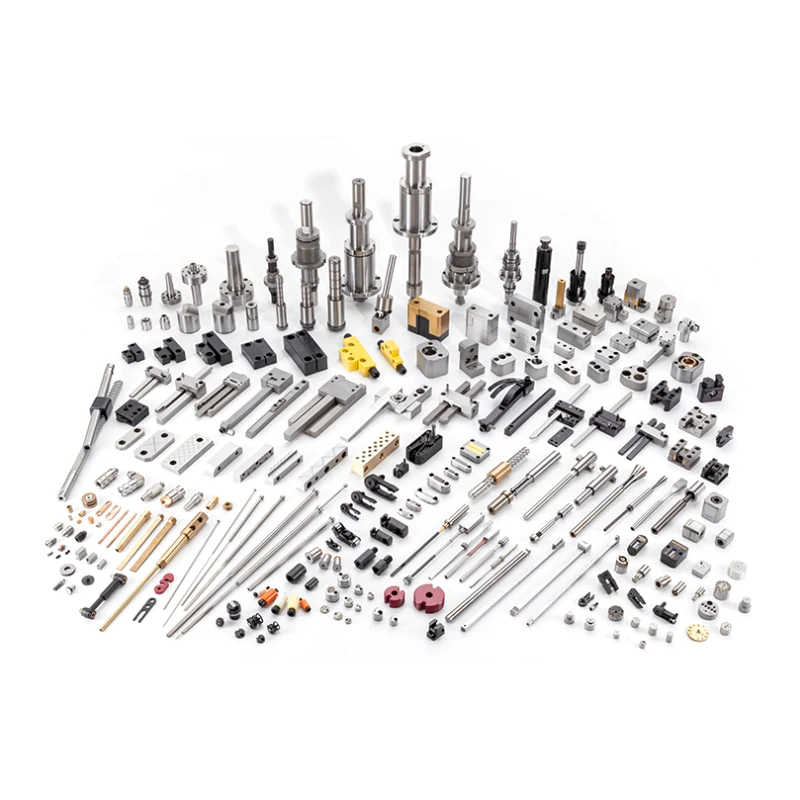
The Mold Base: The Foundation for Everything
The mold base is the carrier for the entire mold. It integrates all functional components—cavity, core, ejection system, cooling system, and gating system—into a precise framework, ensuring they return to the exact same position with every open and close cycle.
Core Components of a Standard Mold Base
| Component | Function |
|---|---|
| Top clamping plate | Fixed to the stationary platen of the injection machine; holds the sprue bushing |
| A plate | Holds the cavity; bears injection pressure |
| B plate | Holds the core; supports the ejection system |
| Spacer blocks | Provide space for ejection stroke |
| Bottom clamping plate | Fixed to the moving platen of the injection machine |
| Ejector plate + ejector retainer plate | Mount ejector pins; transmit ejection force |
| Guide pins and guide bushings | Ensure alignment accuracy during opening and closing |
These plates are stacked, locked with screws, and rely on guide pins and bushings to guarantee position repeatability every cycle.
The Two Core Performance Requirements for a Mold Base
Stiffness comes first. Injection pressure can reach hundreds of kilograms per square centimeter. If the mold base lacks rigidity, it will deform under high pressure—the parting line opens, flash appears; the core shifts, wall thickness becomes uneven; ejector pins bind, and the entire mold must be disassembled.
Precision is second. The fit clearance between guide pins and bushings, as well as the flatness and squareness of each plate, directly determine whether the mold opens and closes smoothly and whether product dimensions remain stable.
Standard Parts: The Cheapest Components That Fail Most Often
Standard parts are all the non-cavity, non-core interchangeable components in a mold. Guide pins, bushings, ejector pins, springs, seals, locating rings, locking blocks—they all count.
They look ordinary, they are cheap to buy, but more than half of all mold failures trace back to these components.
1. Guide Pins and Bushings
The guidance system ensures precise alignment of the moving and stationary halves with every close. Most mold failures begin with loss of guidance accuracy.
Material: SUJ2 bearing steel or SKD11 tool steel, with high-frequency induction hardening to HRC 58-62, followed by precision grinding to Ra 0.2-0.4 surface finish.
Fit Clearance: Typically 0.02-0.05 mm, depending on mold size. Too large, and the core and cavity misalign. Too small, and opening and closing resistance increases, causing galling.
Failure Modes:
-
Galling on pins → caused by insufficient lubrication or uneven loading
-
Worn bushings → end of service life; replace them
-
Bent pins → caused by unbalanced ejection or misaligned clamping force from the injection machine
2. Ejector Pins, Sleeves, and Push Rods
The ejection system sees the highest cycling frequency and the most complex loading of any part of the mold.
Ejector Pins: Made of SKH51 high-speed steel or SKD61 hot-work tool steel, with hardened tips. The fit clearance with the guide hole should be 0.015-0.025 mm. Too tight, and the pin binds. Too loose, and flash appears at the ejection point.
Two main causes of ejector pin breakage: the ejection force is off-center from the demolding resistance center, or the pin is impacted during return.
Springs: Responsible for returning the ejector plate. The most overlooked issue is spring fatigue. After tens of thousands of compressions, the free height shortens. The ejector plate fails to return fully, and the ejector pins strike the stationary half during the next closing.
Check method: Inspect spring free height every 100,000 cycles. Replace if it has dropped below 90% of the original height.
3. Seals and Baffles
Cooling system water leaks are the most common sudden failure on the shop floor.
Seals (O-rings): Made of high-temperature silicone rubber or fluororubber, with upper temperature limits of 200°C and 260°C respectively. Failure is caused by high-temperature aging, hardening, or compression set. Replace every 500,000 cycles or annually, whichever comes first.
Baffles: Redirect water flow direction for localized cooling. The most common failure is scale blockage—especially severe in areas with hard water. Use softened water or add anti-corrosion and anti-scale additives.
4. Locating Rings and Locking Blocks
Locating Rings: Mounted on the top clamping plate, centering with the injection machine nozzle. An incorrect selection causes eccentricity between the nozzle and sprue bushing—at best, material leaks; at worst, both the sprue bushing and nozzle are damaged.
Locking Blocks: Used for slide (side-core) locking. When worn, locking force is insufficient, and the slide shifts backward under injection pressure, causing flash on the side of the product. Inspect locking surfaces regularly for indentations or wear. Do not wait for flash to appear before troubleshooting.
Why Standard Parts Fail Most Often
Standard parts are the most easily standardized, cheapest, and least noticeable components in a mold.
And precisely because they are cheap and unnoticeable, they are the most frequently neglected:
-
Guide pins run dry—nobody checks
-
Springs are used until they snap
-
O-rings leak, and someone wraps tape around them and keeps running
-
Ejector pins are slightly bent, but "they still work"
The cumulative result of all these "it still works" decisions: a spring worth a few dollars breaks, the ejector plate jams, the entire mold is pulled from the machine for repair, hours of production capacity are lost, and thousands of dollars in maintenance costs pile up.
Selection Principles
Mold Base Selection
| Factor | Selection Guideline |
|---|---|
| Mold size | Mold base length and width should exceed the projected area of the part by at least 50% for adequate rigidity |
| Injection pressure | High-pressure materials (PA, PPS) need thicker plates or a mold base with support pillars |
| Mold life | Under 500,000 cycles: standard mold base is sufficient; over 1,000,000 cycles: custom high-strength mold base |
| Injection machine specs | Locating ring diameter, tie-bar spacing, and ejector hole positions must match the machine |
Standard Parts Selection
| Component | Selection Guideline |
|---|---|
| Guide pins/bushings | Diameter ≥ 0.3 × clamping force (empirical); surfaces must have oil grooves or lubrication holes |
| Ejector pins | Diameter ≥ 0.6 × part wall thickness; tip geometry determined by demolding resistance direction |
| Springs | Compression ≤ 75% of maximum allowable; return force ≥ 1.5 × total ejection resistance |
| Seals | Temperature rating must be at least 20°C above mold temperature; compression ratio 15%-25% |
| Locating rings | OD fit tolerance with injection machine platen hole: H7/f7 |
Maintenance: No Technical Complexity, Only Execution Discipline
Mold base and standard part maintenance is not complicated. What it requires is frequency and discipline.
| Frequency | Task |
|---|---|
| Every shift | Lubricate guide pins and bushings; listen for abnormal ejector pin noise |
| Weekly | Check all fastening screws (around the mold base and on ejector plates) for loosening |
| Monthly | Measure spring free height and record; inspect seals for hardening or cracking |
| Quarterly | Check guide pin/bushing fit clearance; inspect locking block wear |
| Annually or every 500,000 cycles | Replace all springs and seals; replace guide pins and bushings based on wear condition |
Fault Diagnosis Quick Reference
| Symptom | Check First | Inspection Method |
|---|---|---|
| Flash on product | Worn guide pins/bushings; insufficient mold base rigidity | Check pin clearance; contact pattern test with red lead |
| Ejector pins do not move smoothly | Bent pins; fatigue springs; worn guide pillars | Check pin straightness; measure spring free height |
| Ejector plate does not return fully | Springs short; guide pillars binding | Replace springs; clean and lubricate guide pillars |
| Water leaks in cooling system | Worn or damaged O-rings; failed baffle seals | Pressure-test cooling circuit; inspect O-ring condition |
| Slide locking failure | Worn locking blocks; worn slide guide rails | Inspect locking surface indentations; measure slide-to-guide clearance |
| Unusual noise during opening/closing | Dry or galled guide pins | Inspect pin surface; lubricate or replace |
The mold base and standard parts do not determine how beautiful the product looks—that is the cavity's job. They determine only one thing: whether the mold can reliably and consistently produce parts over its intended life.
A misaligned skeleton cannot transmit power, no matter how strong the muscles. A stiff joint cannot move, no matter how capable the limb.
When selecting a mold base, prioritize rigidity over lightness, precision over price. When purchasing standard parts, the brand does not need to be the most expensive, but the specifications must be correct. In daily maintenance, replace springs on schedule, lubricate guide pins regularly, and change seals when they reach end-of-life. These tasks require no technical skill—just a checklist and the discipline to follow it.